Showing posts with label culture. Show all posts

Monday, August 17, 2015

The Story in Film


File:16mm filmhjul.jpg
Understanding the Palestinian – Israeli conflict, surprisingly, can be easily achieved.  While there are many books, articles, and blog posts on the subject, through the medium of moving pictures we can take in a broad sweep of events in a short time.  The questions we are left with, of course, can be researched further in books and on the Internet.  Film, however, is the quickest way to begin to get a grasp of the issues and complexities behind and within the conflict.


We recommend starting with the video ‘The Land Speaks Arabic.’  The very idea of creating a modern, secular, geo-political Israeli State in Palestine is only a little more than 100 years old.  Our review as well as links to more information can be found on the post titled, ‘History.’  http://boycott4peace.blogspot.com/2015/02/history.html

To begin to bring your understanding up to current times, our next film recommendation is ‘Five Broken Cameras.’  This film shows the landscape of Palestine, the plight of the Indigenous people still living on their traditional lands today, and their struggle against Israel’s relentless oppression and annexation.  Our review and links to more information can be found here:  http://boycott4peace.blogspot.com/2014/11/5-broken-cameras.html

Palestinian youth also have a story to tell. ‘Slingshot Hip Hop’ shares the story of their efforts to find their voice, not just among Palestinian people, but also in and related to the wider world where many of us are engaged in resisting racism and oppression.  In the film we begin to grasp the effects of Israeli ethnic cleansing on the families that have been displaced within Israel as well as in the West Bank and Gaza, and we get a glimpse of what it is like to live under the illegal Israeli occupation.  We get a good look at the separation walls, the check points, the lack of consistent electricity, and what the effects are on the people’s lives.  The Palestinian Hip Hop movement is traced from its infancy up to today, where it has become a powerful voice.  A powerful voice that is ignored by mainstream media.  

Slingshot Hip-Hop


"When delivering a message, art is more effective than violence.

I consider art to be the most important messenger.

Violence only breeds more violence and destruction."


The movie starts out in Arabic.  After the title shot, there are subtitles in English as well as versions which can be purchased with French of Spanish subtitles.  A portion of the music and discussion is also in English.  You can view the official trailer here: http://www.slingshothiphop.com/trailer/


"Tears can't extinguish hope."
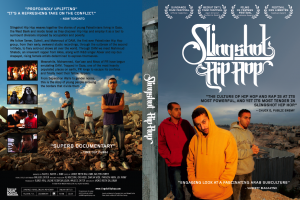

dvd image


'Slingshot Hip Hop' is an important part of the education of anyone who wants to understand the Palestinian - Israeli conflict today.  Available on request from most public libraries and wherever you normally rent movies.  Copies can also be purchased for home use, by educational institutions and libraries, as well as non-profit organizations.  For more information please see:  http://www.slingshothiphop.com/dvd/

~~~

Image Credits:

The reel to reel film photo is from Wikimedia Commons. 
All other images are from Slingshot Hip Hop's web page.

~~~

For all our posts about films or that include information on films, please see:

~~~

Participate!  If you have a favorite Palestinian DVD, especially if it tells a part of the story we haven’t covered yet, please use the comments section below to tell us about it.  We may be able to feature your recommendation in an up-coming blog post. 

~~~
http://www.pinterest.com/boycott4peace/pins/

~~~

E-mail, reblog, tweet, share, or pin, using the buttons below: 

Monday, June 1, 2015

Hungry for Sustainability?


The world hungers for sustainability, and yet we rarely seem to find it.  Meanwhile, we have an ancient and living model of sustainability within our reach.  Struggling to exist in the cradle of civilization, is a culture that has tended the land gently for thousands of years. (1)  Steadfast families still live in small villages, surrounded by fields, orchards, grazing lands, and woodlands that together supply nearly all the people’s needs.  But the world, rather than flocking to learn these ancient lessons of sustainability has turned its back.  These families, this land, suffers under grave and violent threat. (2) 

The photo is of a young man working in his family's field in the Palestinian village of Artas, famous for its Romaine Lettuce. (3) Israeli restrictions on travel to and within Palestine make it difficult or impossible for people to come to buy and trade from the source as they did decades ago. (4) Israel also controls all Palestinian business, the movement and sale of goods within Palestine, as well as imports and exports. (5)  This imperiled ancient culture needs our protection.  We hope that the more you learn, the more you will care.

(1)  The ancient history of this culture is well documented. “ . . . a Neolithic agricultural civilization arose  . . . perhaps as early as 7000 BC  . . . " E.O. James, Archeologist:  http://boycott4peace.blogspot.com/2015/02/archeology-and-hebrew-mythology.html 

(2) To learn about the on-going threat facing these families, we recommend the movie, ‘5 Broken Cameras:’   http://boycott4peace.blogspot.com/2014/11/5-broken-cameras.html


(4)  Scroll down to ‘For More Information,’ to learn more about the travel restrictions that Israel imposes on Palestinians:    http://boycott4peace.blogspot.com/2015/03/free-palestine.html

(5) ‘Israel’s Predatory Economics,’ are covered here: http://boycott4peace.blogspot.com/2015/03/israels-predatory-economics.html  Be sure to read the article in comments as well. 
 
~~~


Be the Change!

The oppression and colonization of Palestine has been going on for over 60 years.  Powerful countries have failed to come to the aid of the Palestinian people, because what is being done to them is of benefit to large wealthy corporations.  It is up to us to be the change.  Please explore our boycott list to see how you may be supporting the erasure of traditional sustainable practices from the Holy Land: http://boycott4peace.blogspot.com/2014/12/boycott-list.html

We also encourage you to take additional nonviolent action in any large or small ways you can.  We have a list of letter writing campaigns and petitions you can sign, and we are starting to share other more involved actions as well.  Whether you have a few minutes or a few weeks, months, or years—there is something you can do! Check our blog every Thursday for calls to action:  http://boycott4peace.blogspot.com/   Quick actions are also very easy to find: http://boycott4peace.blogspot.com/search/label/Quick%20action

Thank you!  It is up to us to create the kind of world we want to live in!

~~~


Participate!

Boycott for Peace would like to feature an article or meme about Palestinian sustainable practices at least a few times a year or even once a month.  We need your help to do this. If you find articles that address Palestinian sustainable practices be sure to share them with us.  If you live in or visit Palestine and can take photos and notes relating to traditional food production, we can help you polish them up and present them to the public.  The wisdom we all need to survive is being imperiled.  Let’s let the world know!

~~~

~~~ 


E-mail, reblog, tweet, share, or pin, using the buttons below:

Monday, February 23, 2015

Archeology and Hebrew Mythology


Palestinian culture began as early as 7000 BC, and was well developed with qualities that can be recognized today as early as 5000 BC.  According to Hebrew (Israeli) narrative, they claim to have conquered Canaan (which they misconstrue as being synonymous with Palestine) around 1000 BC.  However, neither archeological nor ancient texts dating to that era support this narrative.  Unbiased scholars consider this narrative to be largely fictional.  One scholarly view from 'The Ancient Gods,' by E.O. James, (related below), is that the nomadic Hebrew tribes, through a slow and gradual process, settled in the area along side Indigenous Palestinian people.  The result was a culture fusion rather than subjugation or annihilation.

~~~


" . . .  in Syria and Palestine where . . . a Neolithic agricultural civilization arose at Jericho perhaps as early as 7000 BC  . . . "  (pg 34)


"It was not, in fact, until the beginning of the early Iron Age (c. 1200 - 900 BC) that the traditional Hebrew invasion of Palestine began . . ." (pg 35)

"Unquestionably the traditional account of the events and incidents in the quasi-legendary patriarchal period in the book of Genesis, and the final Hebrew settlement in Palestine in and after the middle of the second millennium BC, is largely mythical."  (pg 36)

"In fact the penetration of the invading nomadic tribes was a very gradual process resulting in a fusion which produced a composite culture .  .  ." (pg 38)


E.O. James, Archeologist,  Professor of the History of Religion,  'The Ancient Gods,'  non-fiction.

~~~

Image ~

Paleolithic Palestinian grinding stones.

From Wikimedia Commons.

~~~

Also check our our post on, Ancient Cultural Roots.

~~~

Boycott for Peace! 
http://www.pinterest.com/boycott4peace/pins/

~~~

Use the buttons below to e-mail, reblog, tweet, share, or pin:

Monday, December 29, 2014

Underneath the Forest is Beautiful

Underneath the Forest is Beautiful

Continuity in Palestinian Historical Narratives


The myth of Palestine as an empty and arid land becomes more plausible in the Jewish psyche when all evidence of Palestinian villages are razed to the ground and forests and settlements have been built over them. Israeli narratives of the Jewish people returning to their empty homeland has a more solid impact on the psyche of the Jewish immigrant when Palestinian villages no longer exist to incite any questions on the indigenous population of the area. The role of this post is to point to the fact that the territorial continuity that the Israelis claim to exist between the Hebrews of yesterday and the Israeli settlers of today is not real: it is a constructive narrative of one Jewish organization known as the Jewish National Fund.  (Pappe, Ilan, The Ethnic Cleansing of Palestine, p. 227). 

Destroying any trace of Palestinian villages, farms and orchards in land designated as Jewish in the United Nations Partition agreement has two major objectives in Israeli historical narratives. The first is to focus territorial disagreement between Palestinians and Israelis on land occupied by Israel in 1967. In the Israeli mindset, having no visible trace or evidence of a previous Palestinian presence in Israel removes an possible justification for considering this illegally claimed property and land on the podium of negotiations between the two parties (Pappe, Ilan, The Ethnic Cleansing of Palestine, p. 221).  It also implies that the Palestinian Right to Return will not be recognized because any traces of Palestinian existence in the area has been hidden underneath the forests constructed by the Jewish National Fund. Second, everything in Gaza and West Bank, according to Israel, is open to negotiation due to the illegal Israeli settlements located in the West Bank and currently the illegally confiscated territory in Gaza as security buffers between Israel and the Palestinians living in Gaza.

Just like the olive trees that have been spotted making their way back to the top soil of these forests and overrunning the conifers (pine and cypress trees) that the Jewish National Fund has been so readily to plant instead of the indigenous trees (almond and olive trees) Palestinians have to make their voice heard by commemorating the Palestinian villages that lie underneath the soil. The settlement of Mijda Ha-Emek lies over the Palestinian village of Mujaydil, the settlement of Tirat Hacarmel settles over the Palestinian village of Tirat Haifa, Qiryat Shemona settlement replaced the Palestinian Khalsa village, and Ashkelon settlement has taken over the land the belonged to Majdal. Note that each Palestinian village was replaced by a Hebrew version of the Arabic name.

Not only were entire villages razed to the ground, architectural buildings that called attention to the Palestinian presence in Jewish urban areas were targeted by the Jewish National Fund for destruction in order to maintain the false historical narrative of Jewish only presence in the area. Masjad al Khayriyya in the City of Givatayim and Sarafand mosque in Haifa were destroyed. Church of Birwa in the Jewish settlement of Ahihud no longer exists there. Majdal and Qisarya mosques have been converted to restaurants, and the Beersheba mosque into a shop. Five thousand dunams of Huj village makes up Ariel Sharon’s private ranch of Havat Hashikmim.
 

We must all continue to approach the Palestinian-Israeli conflict from the starting point of the ethnic cleansing of the Palestinian people from their rightful property. The trauma and memory of fear as the Palestinians sought refugee from the horrors of the Jewish militia need to be the starting point in any dialogues between Palestinians and Israelis. We  must work diligently to replace the fabricated Israeli narratives as a continued presence in the area with the authentic version of the ancient and the on-going Palestinian presence in the area. 

~~~


For more information please see ‘Ancient Cultural Roots:’

~~~

Take Action!

Write to the President about Ethnic Cleansing in Palestine:


~~~

Boycott for Peace! 
~~~

Use the buttons below to e-mail, reblog, tweet, share, or pin:
 

Friday, December 5, 2014

Palestinian Embroidery


Palestinian Cultural Heritage

Palestinian Embroidery

Palestinian embroidery is a powerful form of art that captures the rich historical significance of the Middle Eastern culture. Located at the crossroads between Europe and Asia, Palestine costumes have come to embody the sacredness of its role as gatekeepers of all that is prized in each civilization. Today, traditional clothing is primarily worn by the older generation of Palestinian mothers, and by the younger generations during celebrations and festivals. The Palestinian costumes have been widely cherished as a symbol of Palestinian resiliency throughout its history.

The A shape style of the dress can be traced back to 1200 B.C during the days of the Canaanites. The square chest piece and lower back panel are visible symbols adapted from Roman tunics of the seventh century. It does not take a lot to imagine the pride the Palestinian people have for their costumes for them to remain a living part of their heritage from antiquity until today. These cultural characteristics from past predecessors occupy a place in the Palestinian costume as the integration of cultures create the most beautiful masterpieces.

Designs of the Palestinian costumes tell their own narratives of Palestinian identity. The S pattern or the leach pattern indicates the importance of leaches in medicine for treating the ill, historically. The cup shape character on Palestinian costumes is often associated to Jericho, symbolizes the prosperity and wealth in years past. Costumes adorned with the interlacing patterns to represent Jesus and the four evangelists are indicative of the people of Bethlehem. 

In recent years Palestinian women have relied on embroidery as a source of livelihood. Incomes that have drastically decreased to the high unemployment rates of today, high percentage of men imprisoned in Israeli jails and high costs of living have pushed Palestinian women to supplement their incomes by working in embroidery. These women work from their homes for heritage and cultural organizations that then sell the costumes to the public. It is a replica of the British cottage industry of the nineteenth century that allows women to maintain a strong presence in maintaining family values and norms around the home while earning a financial living.

More insight into the cultural importance of  Palestinian costumes influencing medieval dress is found in this lecture given by Hanan K. Munayyer. http://www.loc.gov/today/cyberlc/feature_wdesc.php?rec=5704


Images of Palestinian costumes are located within the website of the Palestine Heritage Foundation. 1. http://palestineheritage.org/gallery.htm
2.https://www.youtube.com/watch?v=boEzq37Y64U
3.https://www.youtube.com/watch?v=YJXC046hzXQ

Visit these stores to empower Palestinian women by buying their handmade products.
1. http://shopinpalestine.com/index.php?cPath=9&osCsid=943372e28b077e54bbaa61de7741cb2c
2. http://www.sunbula.org
3.http://www.sunbula.org/sunbulashop/einside.php?id=95&linkid=95

~~~

Boycott for Peace! 

~~~

Use the buttons below to e-mail, reblog, tweet, share, or pin: