Showing posts with label Buy Palestinian. Show all posts

Saturday, May 9, 2015

Za’atar


Buy Palestinian!


It has come to our attention that some of the Za'atar seasoning sold in bulk at self service herb and spice counters may be of Israeli origin.  However, Fair Trade Certified Palestinian Za'atar is available many places around the world!
Scroll down to find the best way to shop where ever you are.


U.S. or Canada?  Shop on line at the link:  http://www.canaanfairtrade.com/products.php


U.S.A?  Find a shop that carries Za’atar near you, scroll down to the dark green box in the left hand column at the link below, and enter your zip code. 
If it's a bit of a drive call first. The shops  listed all 
carry at least one Palestinian Fair Trade Certified 
gourmet item, but it might not be Za’atar.


Everywhere else, scroll down on this page to see if your country is mentioned. If so click the link to the company and search out their contact information:  
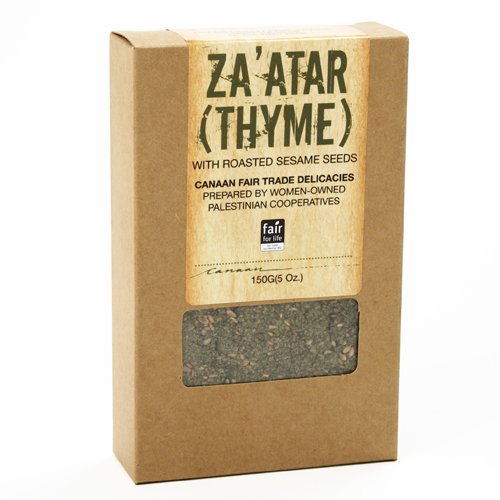


Za'atar Spice Blend from Palestine (5 ounce)Many of the larger solidarity organizations import and resell Fair Trade Certified Palestinian products, including Za’atar. Check your favorites for their product listings, if they do carry Fair Trade Certified Palestinian Za’atar, please feel free to add a link in comments.


If all else fails, there is always Amazon. We don’t like to recommend Amazon, because they are a huge monopoly that underpays its workers and that does not represent the change we want to see. However, we also want everyone who takes a notion to try the real deal as far as Za’atar goes, to be able to do so: http://www.amazon.com/Zaatar-Spice-Blend-Palestine-ounce/dp/B00CL5XP1S
 

~~~

Want to know more about Za'atar?  Get the scoop here:  http://www.canaanfairtrade.com/products/dried-goods/

~~~

Tips for self serve herbs and spices counters, as well as bulk bins:

The Za'atar at your local store might actually be Fair Trade Certified Palestinian.  However, to avoid supporting the occupation when buying dried goods--such as herbs and spices, dried fruits and veggies, seasoning and soup mixes, as well as chickpeas and lentils--you  need to read the label on the bin or jar carefully. If it doesn't state ‘country of origin,’ ‘product of,’ or ‘grown in,' a conversation with store staff is needed. If the clerks can't help you,  you may need to ask for the buyers phone number if they aren't available when you are at the store. You want to ask, first of all, is this a single sourced product. That means that they always purchase it from the same place. If it isn't single sourced, you will never know where the product came from. If it is single sourced, ask about the country of origin.  You might even ask if you can see the label on the original packaging or the catalog description, just to be sure.  Settler grown products are sometimes labeled Palestinian, to try and circumvent the boycotts.  However, only truly Palestinian products can be labeled Fair Trade Certified.

~~~ 

Vote with your dollars! Buy Palestinian!

~~~

Boycott for Peace!
http://www.pinterest.com/boycott4peace/pins/ 

~~~

Use the buttons below to E-mail, Reblog, Tweet, Share, or Pin:

Wednesday, January 7, 2015

Resistance Art


It's not too late to grace your home with a new calendar full of Palestinian Art! 


Resistance Art offers the work of Palestinian artists and writers in the form of calendars, note cards, posters, books, and original art.  Your support not only allows the artists to continue with their work, it helps provide funds to support cultural organizations in Palestine and the Diaspora.


We ordered the calendar pictured on the meme on December 29th.  It was shipped and postmarked the same day, and received on January 5th.  It’s a nice full size calendar, printed on heavy calendar stock—not the flimsy paper many calendars are printed on today.  It was nicely packaged and arrived in good shape.  The printing is professional, and at the end of the year we look forward to framing some of the images.  The price including shipping (for delivery in the US or Canada) is $26.00.   (They can ship anywhere in the world.)  We are happy with the purchase and happy to have the opportunity to support Palestinian art and artists, even if it is in a very small way.  We hope you will visit their website and consider squeezing a little money out of your budget to make a purchase also.   The more of us who make a commitment to Buy Palestinian, the bigger difference we can make!  http://www.resistanceart.com/ 


~~~


~~~

Boycott for Peace!

http://boycott4peace.blogspot.com/ 

https://www.facebook.com/boycott4peace 

~~~

Use the buttons below to e-mail, reblog, tweet, share, or pin:

Friday, December 5, 2014

Palestinian Embroidery


Palestinian Cultural Heritage

Palestinian Embroidery

Palestinian embroidery is a powerful form of art that captures the rich historical significance of the Middle Eastern culture. Located at the crossroads between Europe and Asia, Palestine costumes have come to embody the sacredness of its role as gatekeepers of all that is prized in each civilization. Today, traditional clothing is primarily worn by the older generation of Palestinian mothers, and by the younger generations during celebrations and festivals. The Palestinian costumes have been widely cherished as a symbol of Palestinian resiliency throughout its history.

The A shape style of the dress can be traced back to 1200 B.C during the days of the Canaanites. The square chest piece and lower back panel are visible symbols adapted from Roman tunics of the seventh century. It does not take a lot to imagine the pride the Palestinian people have for their costumes for them to remain a living part of their heritage from antiquity until today. These cultural characteristics from past predecessors occupy a place in the Palestinian costume as the integration of cultures create the most beautiful masterpieces.

Designs of the Palestinian costumes tell their own narratives of Palestinian identity. The S pattern or the leach pattern indicates the importance of leaches in medicine for treating the ill, historically. The cup shape character on Palestinian costumes is often associated to Jericho, symbolizes the prosperity and wealth in years past. Costumes adorned with the interlacing patterns to represent Jesus and the four evangelists are indicative of the people of Bethlehem. 

In recent years Palestinian women have relied on embroidery as a source of livelihood. Incomes that have drastically decreased to the high unemployment rates of today, high percentage of men imprisoned in Israeli jails and high costs of living have pushed Palestinian women to supplement their incomes by working in embroidery. These women work from their homes for heritage and cultural organizations that then sell the costumes to the public. It is a replica of the British cottage industry of the nineteenth century that allows women to maintain a strong presence in maintaining family values and norms around the home while earning a financial living.

More insight into the cultural importance of  Palestinian costumes influencing medieval dress is found in this lecture given by Hanan K. Munayyer. http://www.loc.gov/today/cyberlc/feature_wdesc.php?rec=5704


Images of Palestinian costumes are located within the website of the Palestine Heritage Foundation. 1. http://palestineheritage.org/gallery.htm
2.https://www.youtube.com/watch?v=boEzq37Y64U
3.https://www.youtube.com/watch?v=YJXC046hzXQ

Visit these stores to empower Palestinian women by buying their handmade products.
1. http://shopinpalestine.com/index.php?cPath=9&osCsid=943372e28b077e54bbaa61de7741cb2c
2. http://www.sunbula.org
3.http://www.sunbula.org/sunbulashop/einside.php?id=95&linkid=95

~~~

Boycott for Peace! 

~~~

Use the buttons below to e-mail, reblog, tweet, share, or pin: